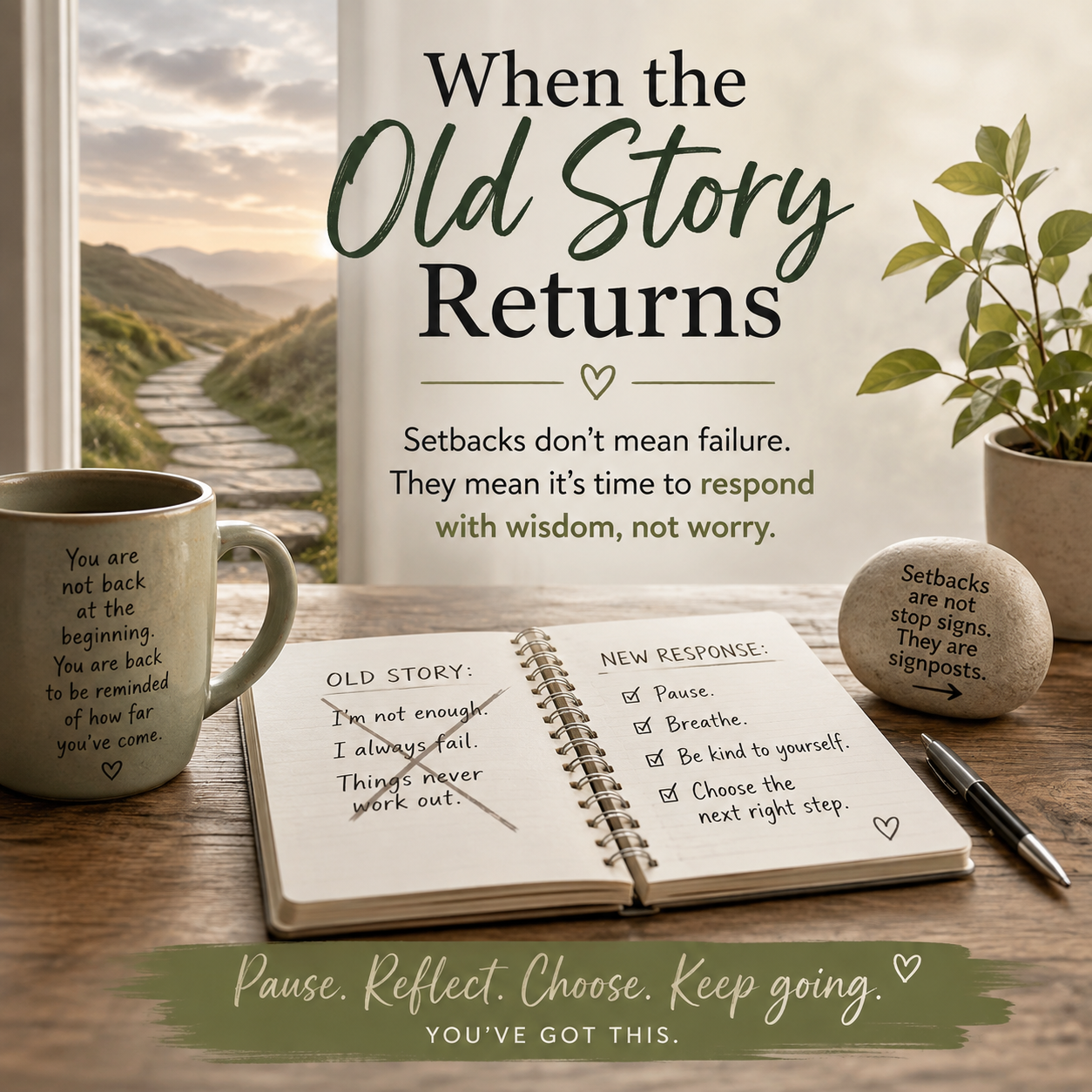
When the Old Story Returns
How to respond to setbacks
Last week, we talked about acting “as if.” You do this not to pretend to be someone you’re not, but to practice being the person you’re becoming. But here’s something important about practice: it doesn’t mean perfection.
You can do the work. You can become more aware of your thinking, challenge old beliefs, create new ones, and make choices that align with the person you want to become. And then one day, seemingly out of nowhere, the old story comes back. I’m not good enough. Maybe I can’t do this. Who do I think I am? Maybe nothing is really changing after all. Sometimes the most frustrating part isn’t even the thought itself, it’s the fact that you’re having it.
I know this one personally. Recently, I found myself feeling frustrated and disappointed about where I was with some things in my business, and before long, familiar thoughts crept back in: self-doubt, questioning myself, wondering whether I was really capable of creating what I wanted to create. Then another layer appeared… I got frustrated with myself for having the self-doubt in the first place. After all, I teach this stuff. I’ve spent years studying mindset, written a book about the stories we tell ourselves, coached other people through these exact kinds of thoughts. So, a new story started forming: If I’m still having self-doubt, how can I possibly help other people with theirs?
Do you see what happened? I had a thought. And then I created a story about what having that thought meant about me. That’s when I had to come back to one of the questions I ask myself and others all the time: What am I making this mean? I was making the return of an old thought mean that I had somehow gone backward. But that wasn’t true.
Old doesn’t mean true.
Some of our thoughts have been with us for decades. We’ve rehearsed them thousands of times, built neural pathways around them, collected evidence for them, repeated them so often that they can feel less like thoughts and more like facts. Doing mindset work doesn’t magically erase them. And becoming a more confident, courageous, peaceful, disciplined, or intentional version of yourself doesn’t mean the old version of you will never speak again. Sometimes she will. The difference is that you don’t have to believe everything she says.
That is the work. Not eliminating every negative thought. Not reaching some magical point where self-doubt never appears again. But becoming better at noticing when the old story has taken over, and remembering that you get to choose what happens next. A setback isn’t the end of the story.
This is especially important when we’re trying to create change. Maybe you’ve been exercising consistently and then you miss a week. Maybe you’ve been setting better boundaries and suddenly hear yourself saying yes when you wanted to say no. Maybe you’ve been speaking to yourself with more compassion and then catch yourself falling right back into criticism. It’s tempting to think: See? I knew I hadn’t really changed. But one moment doesn’t erase everything that came before it. In fact, that moment may be part of the change… because this time, maybe you noticed. This time, maybe you questioned the story instead of automatically believing it. This time, maybe it took you a day to find your way back instead of a month. And eventually, maybe it will take an hour. Then ten minutes. That’s progress too. You can choose again.
I think sometimes we imagine personal growth as this beautiful straight line toward the person we’re meant to become. I haven’t experienced it that way. There are twists, detours, old stories, hard days and moments when you wonder whether anything is changing at all. But perhaps someday you’ll look back at some of those moments you once labeled as setbacks and realize: they weren’t interruptions in the journey. They were part of it. They gave you another opportunity to practice, to notice, to question, to remember who you’re becoming, and to choose again.
So, when the old story returns, and it probably will, don’t make its return mean you’ve failed. Notice it. Get curious about it. Ask yourself, What am I making this mean? Then decide whether that’s the story you want to keep telling. Because you don’t have to start over every time the old story returns. You just have to choose again.
And maybe that’s where the real magic is.
P.S. I put together a free worksheet called When the Old Story Returns. You can use this framework the next time an old story shows up: notice it, name the facts, remember who you’re becoming, and choose again.